The Lamb
The fluffiest cage in the house, and the first one Isaac must break.

The Lamb is a recurring boss in The Binding of Isaac, encountered in the Basement level. It presents as a small, white, fluffy creature with a deceptively innocent appearance, yet it is one of the earliest—and in many ways one of the most thematically loaded—adversaries Isaac must overcome. Its design deliberately evokes the imagery of a sacrificial animal, tying it directly to the game's central metaphor of a child forced to confront the suffocating love of a parent who would rather imprison him than let him go.
In the broader narrative of the game, the Lamb functions as a manifestation of Isaac's mother's obsession. Where other bosses represent external threats or Isaac's own fractured psyche, the Lamb is the embodiment of the very person who locked him in the basement in the first place. Defeating it is not simply a combat encounter; it is the first act of severing the bond that keeps Isaac trapped in the house, in the dark, in the loop of his mother's twisted devotion.
- Role
- Boss (Basement level)
- Affiliation
- Manifestation of Isaac's mother / the House
- First appears
- The Binding of Isaac (original, 2011); carried into Rebirth and sequels
- Level
- Basement
- Thematic association
- Sacrifice, maternal control, the 'innocent' trap
- Status
- Defeatable; drops a random item on death
Lore & Background
The Lamb occupies a singular place in Isaac's bestiary. Most of the creatures he battles are grotesque, multi-limbed, or openly hostile. The Lamb is none of these. It is small, white, soft-looking, and almost gentle in its movements. That very gentleness is what makes it the most unsettling early encounter in the game. It is the visual and narrative embodiment of the question that haunts the entire story: what happens when the person who is supposed to protect you is the one who built the walls around you?
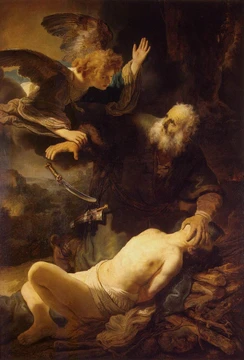
The connection to the biblical Lamb of Sacrifice is not accidental. In the Abrahamic tradition, the lamb is the one that is offered up so that the parent's faith is proven. In Isaac's basement, the roles are inverted. Isaac is the lamb—small, white, confined, expected to be 'saved' by a mother who will not let him leave. The creature that bears his symbolic shape in the game is, in a sense, the part of him that still believes the basement is safe, that the door will open, that the love he feels is real and not a leash. Killing the Lamb is the first time Isaac rejects the narrative his mother has written for him.
In Rebirth and later entries, the Lamb retains this role. It remains a Basement boss, keeping the encounter early enough that the player is still disoriented, still learning the mechanics of the run. The game asks you to destroy something that looks harmless while you are still vulnerable, and the emotional weight of that first 'kill' lingers for the rest of the descent through the Caves, the Depths, and beyond. It is the threshold event: the moment Isaac stops being the child in the pit and starts being the one who climbs out.
In Their Own Story
The basement door groaned open and the light from above was a thin, sickly thing, like a vein pressed against skin. Isaac stood at the top of the stairs, tears already welling, and the smell hit him first—warm wool, milk, the faint sweetness of something that was supposed to be safe.
It was sitting in the middle of the room. Small. White. Its eyes were closed, and it breathed in slow, even pulls, like a child asleep. The walls were wet. The floor was wet. Everything in this house was wet.
He raised his hand. A tear rolled off his fingertip and struck the floor with a soft plip. The Lamb's eyes opened. They were kind. They were so, so kind. And that was the worst part.
"It's okay," the room seemed to say, in a voice that was not a voice. "You don't have to go up. You don't have to be anything. You can stay. You can stay and be small and be mine."
Isaac cried. He always cried. But his hand kept moving, and the next tear was aimed, and the one after that was aimed harder, and the Lamb did not run, did not growl, did not bare its teeth. It simply looked at him with that unbearable, patient love, and let him do it.
When it was over, the room was quiet. The wet walls glistened. And somewhere far above, in a kitchen that smelled of coffee and silence, a woman set down a cup and whispered, "Not yet. Not yet. Not yet."
Reader's Guide
The Lamb is the game's thesis statement in boss form. Edmund McMillen has spoken in interviews about how the original Binding of Isaac was built from his own childhood anxieties—the feeling of being small, of being watched, of loving someone who was also the source of your fear. The Lamb crystallizes that tension. It is not a monster. It is a mother, rendered as a creature, rendered as a thing you must destroy to survive. The game does not let you skip it. It is in the Basement, the first floor, the first room you enter. You cannot run past it. You cannot talk to it. You can only cry at it, and the crying is the attack.
Thematically, the Lamb sits in a long line of 'innocent' antagonists in games and stories—the white rabbit, the gentle ghost, the smiling doll. What makes it land here is the specificity of the relationship. This is not a stranger's threat. This is the person who made the bed, who brought the juice, who locked the door and told you it was for your own good. The player's first instinct, especially on a first run, is to hesitate. The game rewards that hesitation with a slow, almost tender battle. The Lamb's attacks are basic, predictable, almost gentle. You are not fighting a dragon. You are fighting a hug that will not let go.
Reading the game through this lens, every subsequent boss becomes a further layer of the same wound. The Caves are the wider world that still feels like the house. The Depths are the part of you that has given up. And the Lamb, encountered first, is the part of you that still believes if you just cry hard enough, the door will open and someone will say, "It's okay, you can come home." The game's answer, every time, is: no. You have to keep going down. You have to keep crying. And the tears, eventually, become the only weapon that works.
Did You Know?
- The Lamb's visual design—a small, white, fluffy quadruped with closed or half-closed eyes—deliberately mirrors the iconography of a sacrificial lamb, reinforcing the game's central metaphor of a child as the offering.
- As a Basement-level boss, the Lamb is typically one of the first major combat encounters a player faces, meaning the game asks you to 'kill' a symbol of maternal love before you have even reached the Caves.
- The Lamb's attacks in-game are basic and relatively slow, contrasting sharply with the multi-limbed, high-speed bosses that appear in later floors, which mirrors the narrative idea that the most dangerous trap is the one
- In the broader lore of the franchise, the Lamb is one of several manifestations tied to Isaac's mother, connecting it to the recurring theme that the house itself is a character and the 'family' is the antagonist.
More in Lore & Story
Elsewhere in the The Binding of Isaac universe
Spotted an error? Know more?
This is a living reference — every entry is fact-audited, and reader corrections feed straight into our audit queue. Suggest an edit · See this site's audit record