Satan
The last eye opens in the dark, and every sin in the house finally has a face.

Satan is the ultimate adversary of The Binding of Isaac, the towering final boss that guards the Sheol floor—the deepest, most hellish layer of the underground. Depicted as a colossal, multi-eyed, horned figure wreathed in shadow, Satan embodies the game's central theme of a family's twisted religious devotion curdling into something monstrous. It is the last wall between Isaac and escape, and its defeat marks the end of a single run through the basement, caves, depths, womb, and finally the pit of Sheol.
In the broader narrative of the franchise, Satan is not merely a creature to be shot; it is the personification of the sins, guilt, and spiritual corruption that the family has dragged down into the earth. Every room Isaac crawls through, every trap and enemy he slays, is a step closer to confronting the devil his parents' faith has conjured.
- Role
- Final Boss
- Floor
- Sheol
- First Appears
- The Binding of Isaac (2011)
- Affiliation
- Hell / The Devil
- Status
- Defeated by the player to complete a run
Lore & Background
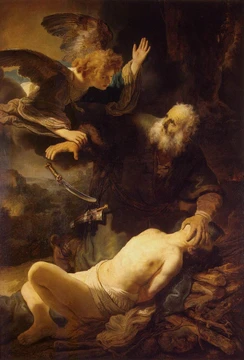
The Binding of Isaac draws its title from the biblical account in which Abraham is commanded to sacrifice his son. In the game's reimagining, the sacrifice never happens cleanly; instead, the child is locked in a basement by a father whose piety has curdled into cruelty, and the mother's devotion becomes a suffocating, possessive force. The underground Isaac explores is not simply a dungeon—it is the psychic architecture of that family's guilt, each floor a deeper stratum of repressed trauma. The Womb, the Depths, the Caves: all are rooms in the house of a broken faith.
Satan occupies the very bottom of that architecture. In the game's visual language, Sheol is rendered in sickly greens, deep purples, and near-total darkness, a place where the walls seem to breathe. Satan looms in the center of that room, its many eyes tracking the small, tear-streaked figure of Isaac. It is not a stranger to this family; in the logic of the game's world, the devil was summoned by the same prayers that locked the door, the same scripture that justified the lock. The horns, the multiple eyes, the vast and terrible mouth—these are the features of a god that a terrified family accidentally gave form.
Fans often read Satan as the culmination of every enemy Isaac has faced: the Gapers that watch, the Brimstones that burn, the Brains that writhe with thought. All of them are fragments of the same household dysfunction, and Satan is the whole. Beating it does not bring peace; it simply lets Isaac walk out of the room, back up the stairs, and face the world above with the knowledge that the thing in the dark is, for now, gone.
In Their Own Story
The last door groaned open and the air changed. It was no longer the damp, metallic smell of the Depths or the warm, fleshy stench of the Womb. This was cold. Cold the way a church is cold in winter, the way a locked room is cold after years. The floor was black stone, veined with something that pulsed faintly, like a vein under skin.
Isaac stood at the edge of the room and looked up. Up was the wrong word. The thing was everywhere at once—horns that scraped the ceiling, a mouth that seemed to contain smaller mouths, and the eyes. God, the eyes. Dozens of them, all blinking in slow, deliberate unison, all watching him with the particular patience of a parent who has already decided the child is guilty.
He raised his tears. They fell upward, defying the room's gravity, and struck the vast dark face. The thing did not flinch. It simply opened another eye.
"You came," it said, in a voice like a hymn sung backwards. "You always come."
Isaac did not answer. He had stopped answering a long time ago. He just kept throwing his tears, and the dark kept opening, and the floor kept bleeding, and somewhere far above, in a house that smelled of bleach and old candles, a door that had been locked for years creaked, just slightly, on its hinges.
Reader's Guide
Satan guards the Sheol floor, the final layer of the run. The arena is a large, dark chamber with a distinctly hellish palette—deep purples, sickly greens, and near-black walls that seem to pulse. Satan itself is a massive, largely stationary figure in the center, its many eyes tracking Isaac as it cycles through attack patterns.
The core of the fight revolves around two threats. First, Satan fires broad projectile spreads—fan-shaped volleys, aimed streams, and slow-homing orbs that fill the room. These require constant lateral movement; standing still is fatal. Second, at set intervals Satan spawns waves of small, fast minions that swarm Isaac from the edges of the room. These minions are individually fragile but dangerous in numbers, and they force you to break your dodging rhythm to clear them.
As the fight progresses, Satan's aggression escalates: projectile patterns become denser, minion waves arrive more frequently, and the overall tempo quickens. There is no traditional "phase two" with a dramatic visual shift, but the pressure curve is steep enough that the final stretch feels like a separate encounter.
Satan has no specific weak point or armor-break mechanic; the strategy is pure endurance and spatial awareness. Keep moving in wide arcs, use the room's corners to limit minion angles, and prioritize clearing minions before they stack. Items and passive upgrades that boost fire rate, projectile count, or movement speed make a significant difference.
Narratively, Satan is the face of the family's accumulated sin. Every enemy Isaac has fought above is a splinter of this same corruption, and the Sheol room is where the splinters are reassembled into the whole. Defeating it does not heal the house. It simply lets Isaac open the door and walk out, tears still falling, into a world that has not changed at all.
Did You Know?
- The name 'Sheol' comes from Hebrew, referring to the abode of the dead or the underworld, making the final floor a direct biblical reference to the realm of the departed.
- Satan's design—multiple eyes, curved horns, a vast shadowy body—is a deliberate echo of the classic 'Baphomet' or 'Lucifer' iconography found in medieval and Renaissance art, filtered through the game's hand-drawn, sligh
- In the game's structure, Satan is the last mandatory boss a player must defeat to complete a full run, making it the narrative and mechanical climax of every playthrough.
- The Binding of Isaac's title itself references the biblical story of Abraham's commanded sacrifice of Isaac, and the game's entire underground can be read as the psychological fallout of that unbroken covenant.
More in Bosses
Elsewhere in the The Binding of Isaac universe
Spotted an error? Know more?
This is a living reference — every entry is fact-audited, and reader corrections feed straight into our audit queue. Suggest an edit · See this site's audit record