The Tears
Every drop is a word he never got to say out loud.

The Tears are the signature projectile of The Binding of Isaac and, by extension, the emotional heartbeat of the entire series. Every playable character in the game attacks not with bullets, blades, or fire, but with small, glistening drops of liquid that arc through the basement corridors. They are at once a core gameplay mechanic—modified by hundreds of items that alter their size, speed, damage, and trajectory—and the central narrative metaphor for Isaac's silent, inescapable suffering.
In a game built around a boy locked in a dark, fleshy underworld by a mother who cannot let him go, those tiny drops of water carry the weight of everything Isaac cannot say. They are his voice, his weapon, and his wound all at once, and the entire world of the game is structured around the act of weeping under pressure.
- Type
- Core projectile mechanic / narrative symbol
- First appears
- The Binding of Isaac (2011)
- Role
- Primary form of attack for every playable character
- Affiliation
- Isaac and all other characters in the series
- Modifiable by
- Hundreds of items affecting size, speed, damage, count, and behavior
- Setting
- The Basement and its deeper layers
Lore & Background
In the world of The Binding of Isaac, tears are not merely a weapon; they are the fundamental expression of a child's interior life made visible. Isaac does not speak in the way other children do. He does not argue, beg, or explain. Instead, he cries, and those tears become the only force he has against the grotesque, fleshy horrors that populate the basement. The game's design makes this literal: there is no dialogue box, no spoken line from Isaac in his base form. His entire interaction with the world is movement and the firing of small, round drops of liquid.
The basement itself is rendered in a palette of sickly pinks, browns, and dark reds, as though the walls are living tissue. In that environment, Isaac's pale, almost translucent tears stand out as the one clean, cold thing present. They are the part of him that is still a child, still vulnerable, still capable of feeling. The items he collects along the way—bottles, pills, strange relics—do not give him a sword or a gun. They give him bigger tears, faster tears, tears that split, tears that burn. Even his power is framed as an intensification of grief rather than a departure from it.
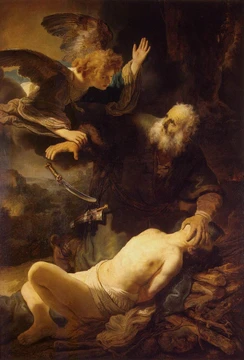
The broader narrative context, drawn from the biblical story of the binding of Isaac, adds a layer of sacrificial weight. A mother who has made her son the center of her entire existence and now tries to keep him bound to her in a dark, inescapable space. The tears are the residue of that binding: the liquid proof that something inside him is still alive and still hurting, even as the world around him warps into something monstrous.
In Their Own Story
The basement door clicks shut with a sound like a knuckle cracking. Isaac doesn't turn around. He never turns around. He just stands in the middle of the room, where the floor is warm and faintly damp, and he feels the first tear well up behind his eyes. It rolls down his cheek, slow and cold, and he blinks it away. But it doesn't disappear. It falls to the floor and sits there, a tiny glass bead catching the dim light of the overhead bulb. Then another. And another. They line up in a small row, like a sentence he can't finish. Somewhere below, something shifts in the walls. Something with too many teeth turns its face toward the sound of wet, quiet weeping. Isaac picks up the first tear. It is heavier than it looks. He aims it at the dark and lets it go, and it sings a small, high note as it flies.
Reader's Guide
The Binding of Isaac is, at its core, a game about a child who has been reduced to a single, involuntary response: crying. Edmund McMillen has spoken openly about drawing from personal experiences with depression and a difficult relationship with his mother, and the game's structure mirrors that. Isaac is placed in a closed, organic space—a basement that feels less like a dungeon and more like the inside of a body—and his only tool is the thing that comes out of him whether he wants it to or not. There is no dialogue. There is no option to talk your way out. You move, you shoot, you die, you try again.
The items that modify tears are telling. You don't find a sword. You find a bigger tear, a faster tear, a tear that splits into three. The vocabulary of the game is the vocabulary of a child's emotional range: more, faster, sharper, more of it. The progression is not mastery of a weapon but the gradual, painful expansion of what one can feel and express. Even the bosses are not defeated so much as endured, wept through, survived.
Thematically, the tears resist the usual power fantasy. They are small, they are slow, they are fragile. The game asks you to find agency in vulnerability, to treat grief as a resource rather than a flaw. In a genre built on explosions and headshots, the Binding of Isaac insists that the most honest thing a person can do is let the water come out and aim it at whatever is trying to swallow them whole.
Did You Know?
- Every playable character in the series, regardless of their visual design or backstory, attacks by firing tears as their primary projectile.
- The game's title references the biblical story in which Abraham is commanded to sacrifice his son Isaac, a parallel the game's basement setting and mother-son dynamic echo throughout.
- Hundreds of collectible items in the game alter tear properties—size, speed, damage, count, and behavior—rather than replacing the tear with a different weapon type.
- The original The Binding of Isaac was created by Edmund McMillen and released in 2011, and its themes of isolation and a suffocating maternal relationship have been discussed by the developer in interviews.
More in Lore & Story
Elsewhere in the The Binding of Isaac universe
Spotted an error? Know more?
This is a living reference — every entry is fact-audited, and reader corrections feed straight into our audit queue. Suggest an edit · See this site's audit record