The Bible
The Word of God, priced at a few coins and sold beside a rusty key.

The Bible is a passive collectible item in The Binding of Isaac, found exclusively in the shop. It transforms Isaac's tears into hearts, turning his offensive arsenal into a stream of self-healing. In a game saturated with religious iconography—from the Garden of Eden to the Devil and Angel encounters—The Bible stands as one of the most thematically loaded objects in the item pool, a sacred text that, in the wrong hands, becomes a tool for survival rather than salvation.
As a shop item, The Bible is relatively uncommon and often appears alongside other purchasable trinkets, making it a moment of quiet irony: the Word of God sits on a dusty shelf next to a rusty key and a bag of coins, waiting for a desperate child to buy it with his last few dimes.
- Type
- Passive Item
- Category
- Shop Item
- Primary Effect
- Converts tears into healing hearts
- Location
- Shop
- Game
- The Binding of Isaac
- Thematic Role
- Religious/sacrificial motif
Lore & Background
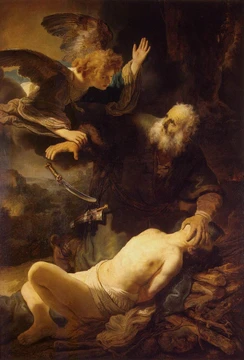
In the world of The Binding of Isaac, religious imagery is not mere decoration—it is the architecture of the narrative. Isaac, the titular son, is bound to a sacrificial altar by his own father, a direct inversion of the Genesis story in which God spares Isaac and demands a ram instead. Here, the father is the one who demands the sacrifice, and the child must fight his way out of the basement, the caves, and the depths of the underworld to survive. Every level, every room, every collectible drips with this theological weight.
The Bible, as an item, occupies a strange and poignant place in that architecture. It does not grant power in the conventional sense. It does not summon demons or split the earth. Instead, it takes the weapon—the tear, the projectile, the means by which Isaac fights his way through monsters and his own father—and transfigures it into something that mends. In a game where the player is perpetually wounded, perpetually bleeding, The Bible whispers a different theology: that the act of striking outward can become an act of healing inward.
Fans often note the bitter irony of the item's placement. It is a shop item, a commodity. The sacred text is reduced to a transaction, a line item in a vendor's inventory. This mirrors the game's broader critique of faith as something that can be bought, packaged, and sold back to the believer. The Bible does not speak to Isaac. It does not offer comfort or revelation. It simply sits there, waiting to be purchased, its pages full of a story that, in this world, has already been twisted beyond recognition.
In Their Own Story
The shop was dark, lit only by the faint amber glow of a single bulb hanging from a wire. The Bible sat on the middle shelf, its cover worn to a soft brown, the gold lettering on the spine barely visible. Around it: a cracked mirror, a bag of coins that clinked when the wind shifted, a small vial of something that smelled like iron and rain.
Isaac stood in the doorway, tears already welling. He hadn't meant to cry. He never meant to. But the basement had been long, and his father's voice still echoed in the walls, still called his name in that low, patient tone, the way a man calls a dog to heel.
He reached into his pocket. Three coins. He set them on the counter. The Bible slid into his hand, heavier than it looked, warm, as though someone had just set it down.
He opened it. The pages were blank. All of them. Just blank, cream-colored pages that smelled of old paper and something faintly sweet, like honey left too long in the sun.
He closed it. He walked back out into the dark. His tears fell, and where they hit the floor, small red hearts pulsed once, twice, and were gone.
He kept walking.
Reader's Guide
The Binding of Isaac is, at its core, a story about a child trapped in the theology his father built for him. The basement is the church. The monsters are the doctrines. The father is the God who demands the son. And the items—every single one—are the scraps of faith the child can grab on the way out.
The Bible, in this reading, is the most honest item in the game. It doesn't pretend to be a weapon. It doesn't summon an angel or call down fire. It simply says: your pain, the very tears you shed, can be turned into something that heals you. It is the one item in the pool that reframes suffering as sustenance rather than punishment.
Edmund McMillen has spoken in interviews about the game being a metaphor for depression and the feeling of being trapped in a narrative you didn't write. The Bible fits that reading perfectly. It is not a promise of salvation. It is a small, quiet mechanism for keeping yourself alive long enough to find the next door, the next room, the next chance to walk further from the altar.
Players who find The Bible in the shop often describe a strange, almost tender moment. In a game of screaming demons and grotesque bosses, picking up a worn book and watching your tears become little red hearts is, for a few seconds, the closest the game gets to grace. Not redemption. Not forgiveness. Just the quiet, stubborn act of not bleeding out in the dark.
Did You Know?
- The Bible is one of the few items in The Binding of Isaac that converts an offensive mechanic (tears) into a purely defensive one (healing), making it a strategic trade-off rather than a straightforward power-up.
- As a shop item, The Bible is subject to the game's shop generation system, meaning it can appear alongside other purchasable items and is not guaranteed to be found in a run.
- The game's heavy use of biblical and religious imagery—Garden of Eden, the Devil, the Angel, the Sacrifice—frames The Bible not just as a gameplay object but as a narrative symbol within a story that inverts the Genesis
- The Bible's effect of turning tears into hearts creates a unique interaction in a game where the player's primary attack is also their primary vulnerability, as every shot fired becomes a potential point of self-repair.
More in Lore & Story
Elsewhere in the The Binding of Isaac universe
Spotted an error? Know more?
This is a living reference — every entry is fact-audited, and reader corrections feed straight into our audit queue. Suggest an edit · See this site's audit record