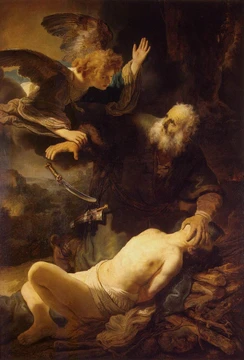
The Angel
A halo of light, a fist of fury—God's messenger has forgotten which side it serves.

The Angel is a towering, luminous boss that haunts the Depths in The Binding of Isaac: Rebirth and its subsequent expansions. Rendered as a vast, white, winged figure suspended in the dark, it embodies the game's recurring motif of divinity twisted into something alien and hostile. Where biblical angels are messengers of grace, this entity is a predator cloaked in holiness, forcing Isaac to fight back against a power that was never meant to be questioned.
As a boss encounter, The Angel sits at the top of the Depths' challenge hierarchy, serving as a final test before the player can press deeper into Isaac's descent. Its presence reinforces the game's central tension: the sacred and the profane are not opposites here, but two faces of the same broken god.
- Role
- Boss
- First appears
- The Binding of Isaac: Rebirth (2014)
- Location
- The Depths
- Affiliation
- Corrupted angelic / divine forces
- Status
- Defeated by the player
Lore & Background
In the twisted cosmology of The Binding of Isaac, the angelic order is not a benevolent hierarchy but a fractured, jealous pantheon lashing out at a child who has stolen the narrative from them. The Angel, as it manifests in the Depths, is less a guardian and more a ward—a living lock on the door between Isaac and whatever waits below. Its white plumage and serene geometry contrast violently with the jagged, fleshy corridors of the Depths, making it feel less like a resident and more like an intruder, a seal pressed over a wound.
The Depths themselves are a liminal space: not quite the basement of the mother's house, not quite the underworld, but a purgatorial layer where the rules of the game soften and the lore thickens. The Angel occupies that ambiguity. It does not speak, does not taunt. It simply descends, unfurls, and rains fire. In the game's visual language, its stillness is more threatening than any snarling demon, because it implies a certainty of purpose that the more chaotic enemies lack.
Fans often read The Angel as the game's most literal expression of its title's theology: Isaac is bound not by chains but by expectation, and the Angel is the expectation made flesh. To slay it is not to win a fight but to reject a role that was written for him before he could speak.
In Their Own Story
The corridor at the bottom of the Depths is silent in a way the upper floors never are. No distant dripping. No creaking of the fleshy walls. Just the faint hum of something enormous settling into the air above the grid of tiles.
Isaac stops. His tears pool and evaporate before they hit the ground. Above him, the Angel folds its wings like a book closing on a sentence it never intended to finish. The light it casts is not warm. It is the white of a surgical lamp, the white of a blank page, the white of a mother's face when she has decided something and will not be argued with.
He does not run. Running is what the upper floors taught him. Here, in the quiet, he simply raises his hands and lets the first tear fly. The Angel does not flinch. It does not need to. It has been waiting a very long time for a child to hit it back, and it finds the gesture almost tender.
The light dims by one degree. The wings shift. And the Depths exhale.
Reader's Guide
Reading The Angel through the lens of Edmund McMillen's broader design philosophy, the boss functions as a thematic punctuation mark rather than a mechanical one. The Depths in Rebirth were conceived as a space where the game's rules loosen—items behave differently, the pacing slows, and the visual palette drains toward grey and white. The Angel is the apex of that drain: a figure so stripped of narrative context that it becomes pure symbol.
Developer commentary around Rebirth's development frequently touched on the idea that the game was about a child processing a trauma he cannot name, and that the enemies were not villains but manifestations of that processing. The Angel fits this reading perfectly. It is not evil. It is not even angry. It is a fixed point in Isaac's emotional landscape, a moment where the story says, 'This is what being expected to be holy looks like from the inside.'
Thematic interpretation from the fan community often groups The Angel with the game's other 'silent' bosses—entities that do not monologue, do not gloat. Their silence is the point. In a game where the mother screams, where the house groans, where the basement hisses, the Angel's quiet is the loudest thing in the Depths. It is the sound of a door that will not open, rendered in feathers and light.
For players who reach it, the encounter is short and almost anticlimactic mechanically, which is itself the design's argument: you do not need a grand victory. You need to look the expectation in the eye and throw one small, tear-stained projectile. That is enough. That is the whole game.
Did You Know?
- The Angel's visual design deliberately inverts the game's usual palette: where most enemies in the Depths are rendered in dark reds and browns, The Angel is almost entirely white, making it read as a negative space in th
- The Depths, where The Angel resides, only appear in a subset of runs, meaning many players never encounter the boss without specific conditions being met—making it a rare, almost mythic figure in the community's shared m
- In the broader narrative of the series, angelic figures consistently appear as antagonists or obstacles rather than allies, reinforcing the game's subversion of traditional biblical iconography where the sacred is the th
- The Angel's encounter is notably quiet compared to other bosses in the game, with minimal on-screen text or taunts, a design choice that players frequently cite as making it feel more unsettling than more aggressive oppo
More in Lore & Story
Elsewhere in the The Binding of Isaac universe
Spotted an error? Know more?
This is a living reference — every entry is fact-audited, and reader corrections feed straight into our audit queue. Suggest an edit · See this site's audit record